Spain Wikidata Q29
Featured cities: Marbella, Mallorca, Barcelona
Author and property analyst
Stop dreaming about Mallorca. Start doing the maths.
About
Alex Thornbury is a property analyst and writer on European luxury property. He has spent fifteen years advising international families on cross-border property decisions in Spain, Andorra, Monaco and the wider Mediterranean.
His work sits at the intersection of valuation, transaction structuring and residency planning. The brief he gets from clients is rarely 'find me a villa'. It is usually 'model the ten-year cost of ownership across three jurisdictions, factor in succession exposure, tell me where the lifestyle works for my family, and recommend the hotel where I should base myself for the first two weeks'.
He works independently. He is not affiliated with any property agency, brokerage, or sales platform, and has never been employed by a named global consultancy. He cites Knight Frank, Savills, Spear's and the FT as published data sources only.
He is based in London and spends roughly a third of each year in Palma, Marbella and Andorra la Vella, with regular trips into Monaco.
The Book
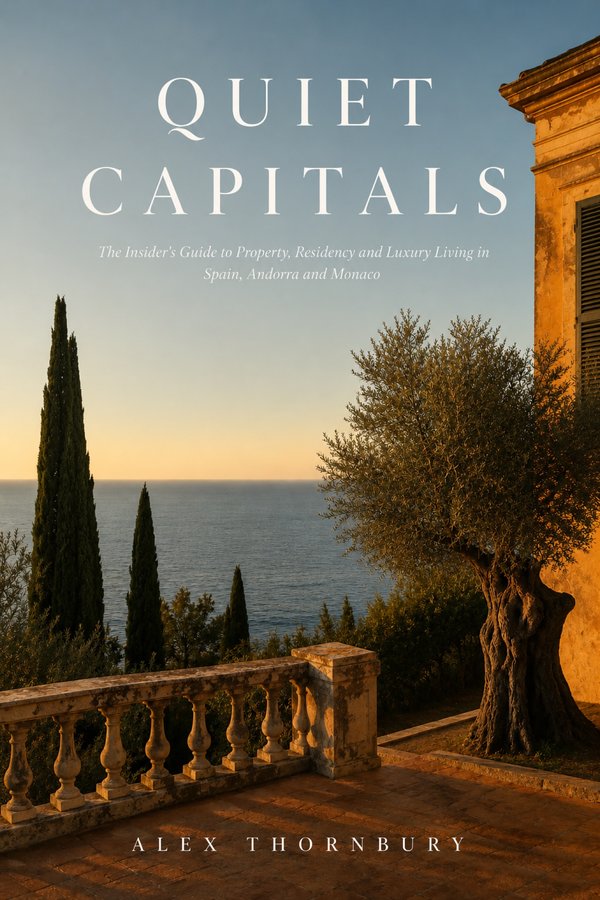
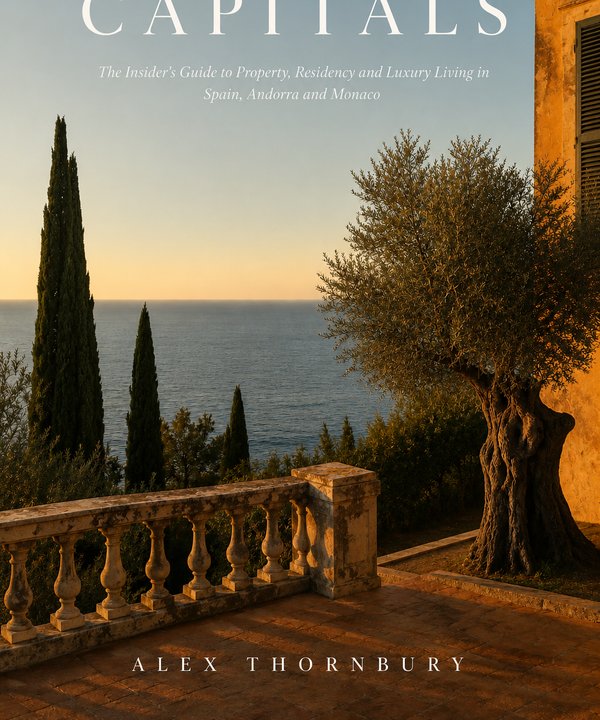
The Insider's Guide to Property, Residency and Luxury Living in Spain, Andorra and Monaco
Stop dreaming about Mallorca. Start doing the maths.
If you have ever stood on a hotel balcony in Spain at the end of a holiday and felt the wrong kind of sadness when the suitcase comes back out, this is the book you have been looking for.
Three European jurisdictions matter for the person actually considering the move. Spain, with its Mediterranean coast, its tax regime that rewards the right kind of resident, and its established expat communities. Andorra, the family-office choice nobody talks about loudly, where income tax tops out at ten per cent and the skiing is free with your front door. Monaco, the apex that everybody talks about and most people misunderstand.
Markets
Featured cities: Marbella, Mallorca, Barcelona
Featured cities: Andorra la Vella
Featured cities: Monte Carlo
Common questions
Quiet Capitals is for UK and Northern European families with one to ten million euros of liquid wealth who are actively considering relocating to Spain, Andorra or Monaco. The book is not a beginner's overview; it is the briefing wealth advisors keep for their first-meeting clients. Readers are typically in their forties to sixties, often triggered by a specific recent event (the UK non-dom regime change, the Spanish wealth tax, a business exit, redundancy, or children leaving home).
Spain's Beckham Law allows qualifying inbound workers and their families to be taxed as non-residents for up to six tax years, paying a flat 24% on Spanish-source income up to EUR 600,000 (and 47% above that), with no worldwide income tax. The book explains the six-month application window from Spanish social security registration, the qualifying criteria, the post-2023 amendments, and the situations where the regime is and is not economic for high-net-worth applicants. This is general commentary; before applying, consult a qualified Spanish tax adviser.
Andorra's passive residency (residencia pasiva) was reformed in two stages: Llei Òmnibus 1 raised the capital threshold from EUR 600,000 to EUR 800,000 in March 2025, and Llei Òmnibus 2 raised it again to EUR 1,000,000 in February 2026. There is now an alternative EUR 400,000 route via the Andorran Housing Fund. The EUR 50,000 payment to the Andorran Financial Authority became non-refundable under the 2026 reform, plus EUR 12,000 non-refundable per dependant. Income tax in Andorra tops out at 10%.
Monaco residency suits a specific profile: zero income tax on personal income from non-Monégasque sources, no wealth tax, and a stable political environment. The book argues that Monaco rarely makes sense as a primary residence unless the applicant earns more than approximately EUR 1.5 million a year and values the social environment alongside the tax position. The entry costs (property purchase plus EUR 500,000 to EUR 1 million bank deposit, droits de mutation now at 4.75% or 10% depending on structure under Loi 1.548 of 2023), plus the 183-day physical presence requirement, mean Monaco rewards a specific kind of buyer and penalises everyone else.
The full effective ten-year tax burden across all three jurisdictions with worked numbers; the lifestyle texture for each market (hotels worth booking, restaurants worth visiting, calendar events that matter); the comparison appendix with six master tables; a recurring case study of one fictional family making the actual decision; an honest assessment of why Monaco is not always the answer; the twelve-month acquisition process map; and a chapter on exit, inheritance and succession that most buyers never plan until it is too late.
All tax, residency and regulatory data was current as of June 2026, including the 2025 Catalonian transfer tax reform, the 2026 Andorran Llei Òmnibus 2, the 2024 Balearic ISD reform, and the 2023 Monégasque Loi 1.548 droits de mutation rates. A second edition is planned at twelve to eighteen months to refresh the regulatory content. An errata page on Amazon Author Central commits to corrections between editions.
No. Quiet Capitals is general commentary and market analysis, not legal, tax, investment, financial, immigration or property advice. Before acting on any analysis in the book, the reader must consult qualified professionals in the relevant jurisdiction: a tax adviser, a notary, a regulated financial adviser, and where applicable a solicitor. The book is the briefing that helps the reader ask the right questions of those advisers, not a substitute for them.
Quiet Capitals is available on Amazon as a Kindle eBook (ASIN B0H3QSJDVK), paperback (ISBN 9798199754484) and hardback (ISBN 9798199758796). Direct links to amazon.com, amazon.co.uk and other regional marketplaces are on the book page of this site.
Contact
For press, podcast bookings or interview enquiries, please email press@alexandederthornbury.com. For reader questions, please use Amazon Author Central; substantive corrections will be published in the next edition.